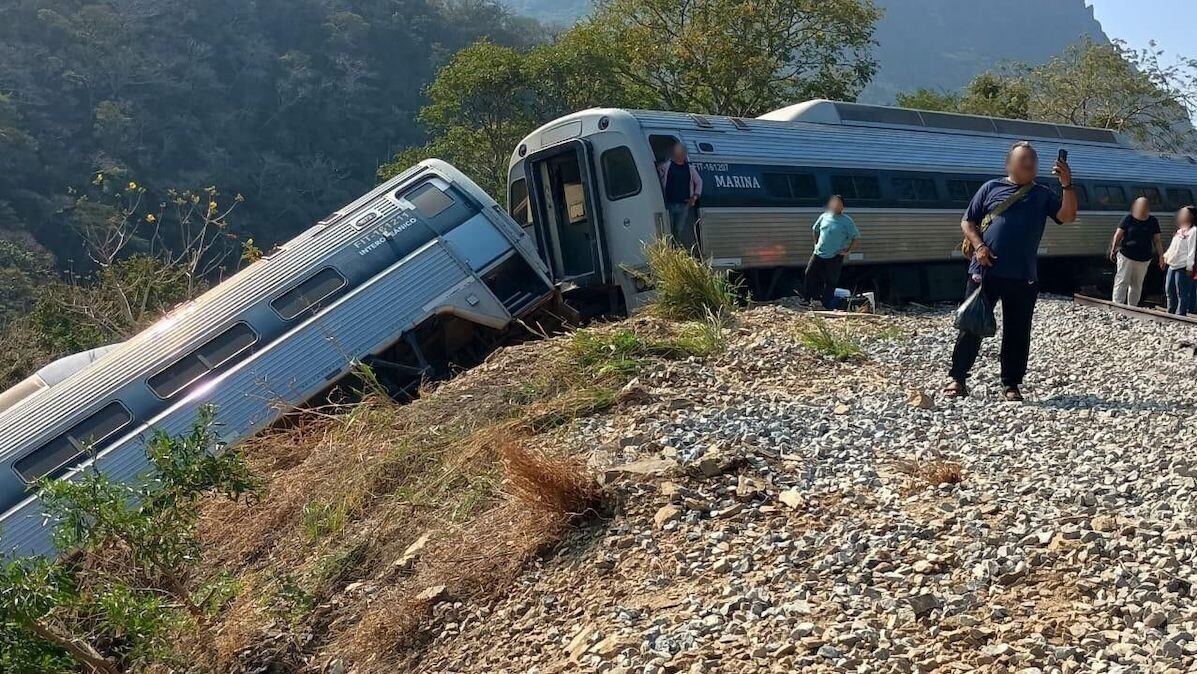
The Attorney General's Office (FGR) presented a new report on the accident on the Z Line of the Interoceanic Train, which occurred in Oaxaca and left 14 dead and over 100 injured. After a wide-ranging technical and expert investigation, the institution concluded that the disaster was caused by excessive speed attributable to the operational personnel, ruling out failures in the railway infrastructure or irregularities in the project's execution.
Investigation points to operational negligence According to the FGR, “the negligent excessive speed attributable to the engineer, as well as the omission of the conductor and the chief dispatcher to prevent it” was the direct cause of the derailment. The investigation involved 336 public officials and more than 230 expert reports, including studies from UNAM.
In terms of victim assistance, 145 people have signed reparatory agreements. The prosecutor's office assured that it acted with institutional rigor: “We have deployed all capacities [...] to arrive at the truth of the facts” and concluded: “Below the law nothing, and above the law no one.” The agency explained that due to the weight of the train, the increase in centrifugal force on a curve caused the cars to derail as they exceeded the permitted limits.
The prosecutor detailed that the criminal responsibility of three people—the engineer, the conductor, and the chief dispatcher—was established, who “knew their duties contained in the internal railway transport regulation,” but committed omissions that led to the accident. Attorney Ernestina Godoy assures that the FGR under her command “carried out all the necessary work to bring to a successful conclusion” the investigation into the derailment of the Interoceanic Train.
She confirms that the commission of the crimes of negligent homicide and injuries was accredited “with…”
Therefore, they were linked to the process for the crimes of negligent homicide and injuries. In contrast, the report emphasizes that the infrastructure was in adequate condition. “It was verified that at the point of the disaster, the track, sleepers, fastenings, and ballast met the standard,” and did not show previous damage that could have caused the incident. Likewise, irregularities in contracts or public resource management were ruled out.